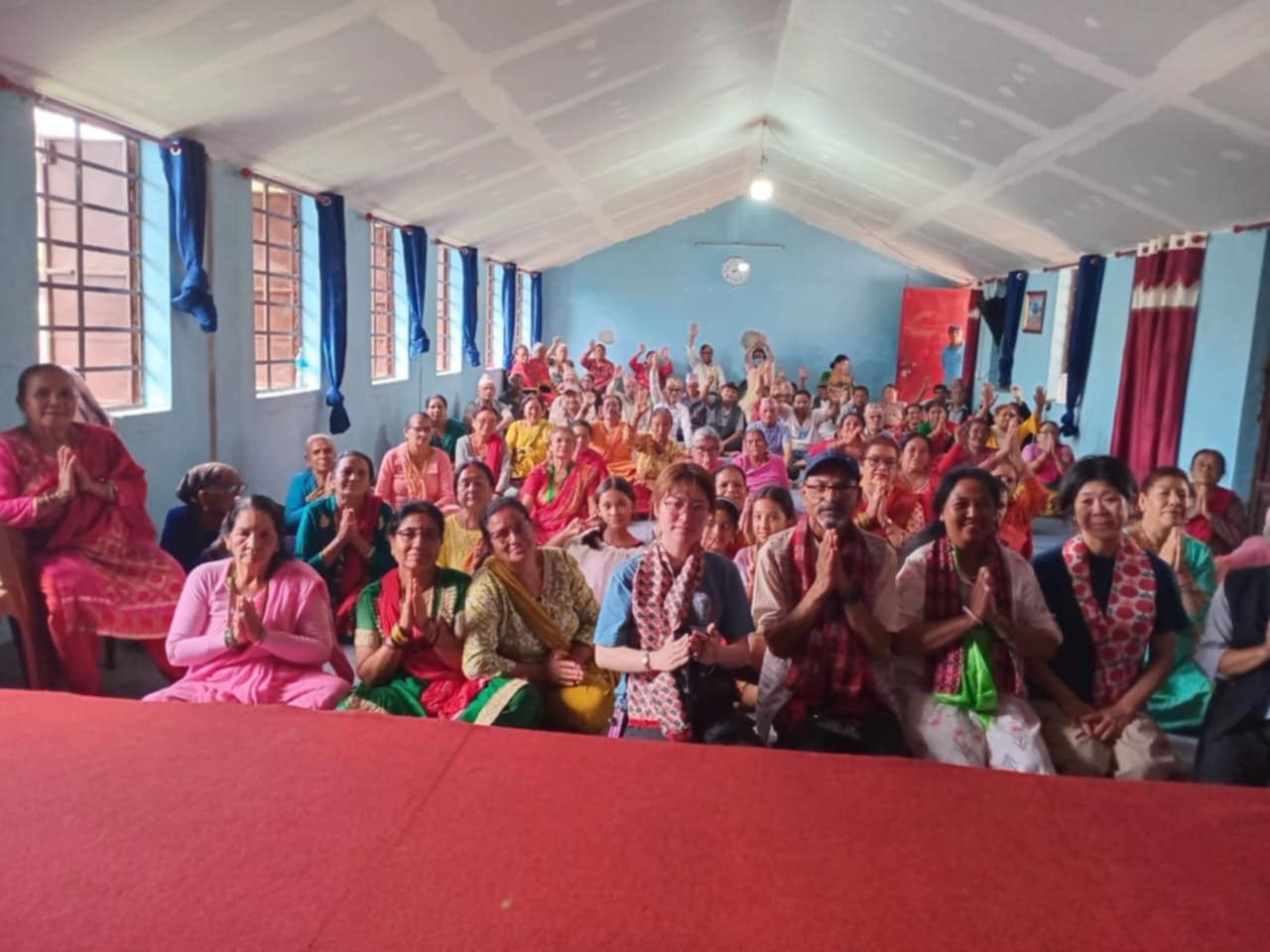
The majority
of older people are illiterate particularly in developing countries due to
social taboos on girls’ education and limited academic institutions during
1960s. This bunch of illiterate youth especially girls of 1960s and older
people of today is struggling to live a normal life in present day society. In
Nepal, more than 80% of older women are illiterate (CBS 2021). So, Ageing Nepal
conduct Basic and Digital Literacy Class for Older People focusing older women.
Literacy
empowers all including the older people. Without literacy it is extremely
difficult for an older person to meaningfully participate in socio-political
and economic facets of the society. Moreover, illiteracy in old age adds more
challenges for older people, especially for those who are living in urban areas
in their later life. It is worth noting that the world is going through a trend
of fast urbanization. In urban life, literacy is taken for granted, and without
it older people become dependent on others even for small activities which they
could do by themselves if literate, like: using TV remote, making phone calls,
visiting their doctor, travelling in public vehicles, crossing the road,
shopping, and so on. They have to be
dependent on their family members who are already under time pressure and may
not be willing or able to help.

Considering
this, NGO Committee on Ageing and Virginia Hazzard Legacy Fund piloted a six
months literacy project in four developing countries, i.e., Nepal, Togo, Mali
and Mozambique.
Ageing Nepal
in collaboration with Shree Asthabhuja Samaj- a local organization,
piloted the project in Budanilkantha municipality ward no. 10, an area with
high migration rate and rapid urbanization.
Thirty older people, 28 women and 2 men were selected through home
visit. Two experienced teachers were hired for daily 2 and half hours teaching
learning processes. The Neo-learners were empowered with basic skills of (a)
reading, writing and numeracy in Nepali and English and (b) using home
appliances and mobile phone.
Since this
beginning in 2016, Ageing Nepal has successfully replicated the class in seven different
communities. On the basis of research on cognitive capacity of older people and
under guidance of Prof. Helen Abadzi, Psychologist (PhD), Research Faculty,
University of Texas at Arlington, a text book for older people was developed.
Similarly, a teacher guide book is also developed. All four classes conducted
so far were handed over to the local government. All of the classes were
continued with support from their respective local governments.
The programme
broke social norms that the older people particularly women cannot learn new
things. It empowered older people to live their old age actively. The project
not only gave higher degree of independence to the learners through added
ability to do things they could not do before, but also gave more friends whom
they can call for help on difficulties, share time to avoid loneliness and as a
group deter possible incidence of elder abuse. Recently, Ageing Nepal conducted
survey among older learners who attended the basic literacy class. The survey
proved that the class became successful to change the life of neo-learners and
the attitude of their family and neighbors towards them.
Ageing Nepal
has already been implemented 9 classes in different communities in
collaboration with local organisations. The literacy programs have been
successful to win UNESCO King Sejong Literacy Prize 2020.
“All the
family members seemed busy all the time. It was hard to find anyone to talk to.
When I tried to help my daughter-in-law with household chores, they would not
allow me, saying, “You don’t know…” It hurt deeply. I felt ashamed, worthless,
and lonely. I depended on them even for small things, seeing a nearby doctor,
identifying medicines, going shopping, making phone calls, changing TV
channels, things I could not do simply because I was illiterate. But that is
all in the past now. The basic literacy class has made me an independent and
active woman again, with many new friends. I got my life, friends, and freedom
back. These days, I even help my great-grandchildren with their homework”, Older
woman, 78.
‘We have a
phone at home but I generally had to wait for some grandchild to come from
school and dial the phone for me. But the time has changed amazingly after I
enrolled in the literacy class. Now, I can use phone, do simple addition and
subtraction and can read the packet label. I am no more afraid of going out
alone and get lost because I can read route number of the bus. Sign boards and
street numbers. Not only this, I gained many friends to talk to and share my
feelings. Confidence building sessions have enabled me to put my opinion
strongly to a group of strangers.’ -71, older woman
‘After first few happy days in Kathmandu my illiteracy started coming down heavily on me as a curse. I started suffering loneliness, feeling useless, facing shame often and leaving as dependent though I am physically fit. I could not go anywhere because of the fear of getting lost. I could not use electronic gadgets, recognize my medicine and so on. But, now no more such things, I am literate woman, you know? And her pride shines’.- 60, older man.